
Overview
The 1 Day Tour from Agadir to Taroudant is the single best day trip from Agadir — and one of the most rewarding short excursions in all of Morocco. While Agadir itself is a modern beach resort rebuilt after the 1960 earthquake, Taroudant is its exact opposite: an ancient walled city that has barely changed in centuries, with two complete circuits of pisé ramparts, two distinct souks (Arab and Berber), an active tannery, a famous silver jewellery market, and a population that goes about its daily business with almost no reference to tourism.
They call Taroudant the Grandmother of Marrakech — and the comparison is apt. Like Marrakech it has kasbahs, souks, a tannery, and ochre mud walls. Unlike Marrakech, it has almost no foreign visitors, no hustlers, no tourist restaurants. What you find instead is an authentic Moroccan market city in full daily operation — families buying vegetables, craftsmen working leather and silver, spice merchants blending argan oil and ras el hanout in quantities meant for local kitchens rather than tourist bags.
The drive from Agadir east through the Souss Valley is itself part of the experience — a wide fertile plain of citrus groves, tomato fields, banana plantations, and the distinctive silhouettes of argan trees, the thorny, gnarled trees found only in this region of the world. The Anti-Atlas Mountains form the southern horizon; the High Atlas close the valley to the north. It is one of Morocco’s most productive agricultural landscapes, and the scale of it — stretching east toward the desert for over 150 kilometres — gives a powerful sense of how much of Morocco’s food comes from this single valley.
Highlights
- Drive east through the argan-rich Souss Valley with Anti-Atlas views
- Enter Taroudant through its magnificent ancient city gate
- Guided walk through the Arab souk — spices, textiles, ceramics, and daily life
- Visit the Berber souk — Morocco’s most authentic weekly market experience
- Explore the silver jewellery souk — Taroudant’s speciality and most beautiful craftwork
- See the active tannery — leather working on a small scale, completely authentic
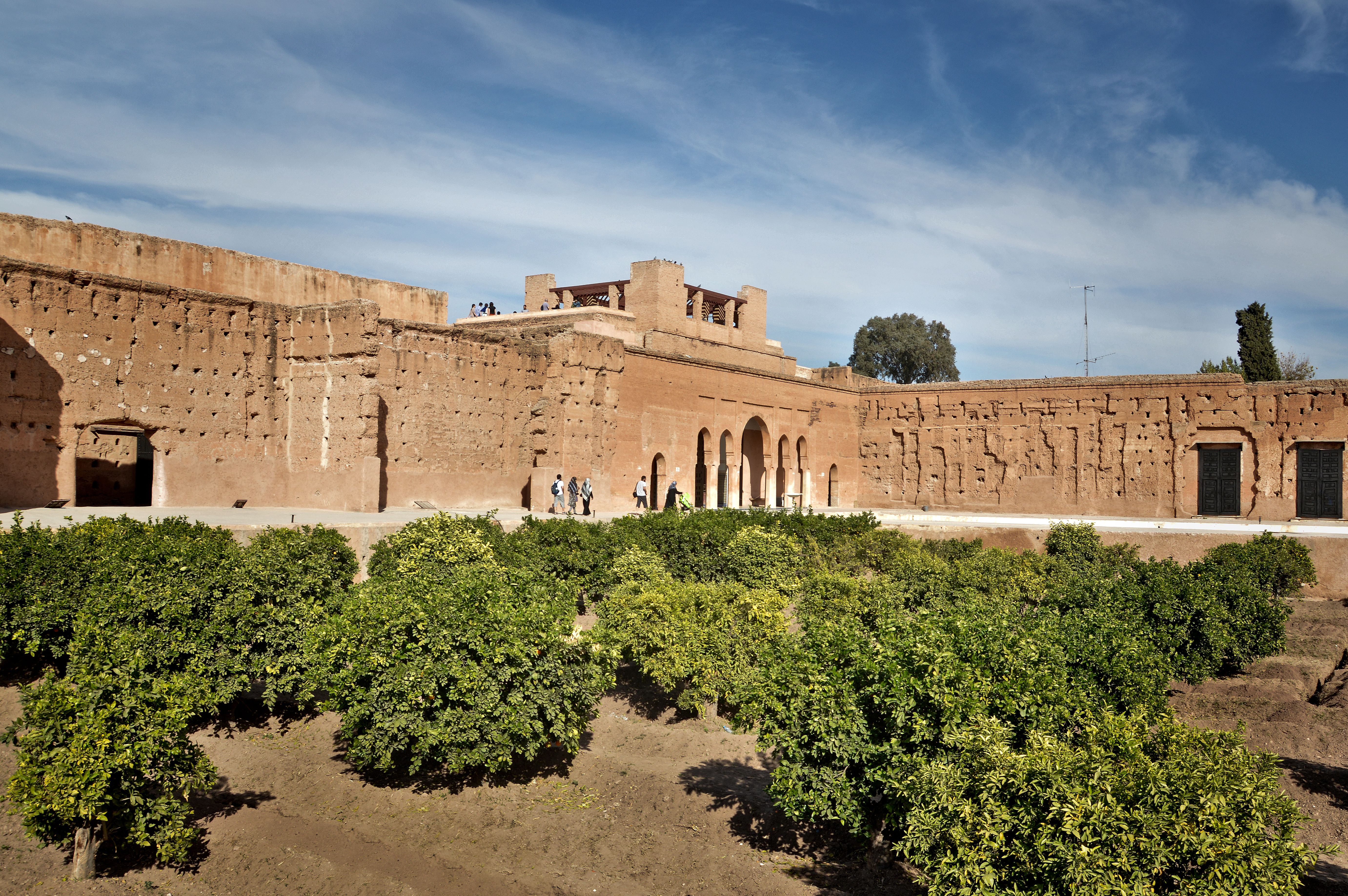
- Walk the Saadian kasbah ruins — a city within the city
- Circle the ancient city walls — one of Morocco’s most complete set of ramparts
- Lunch in a traditional Taroudant restaurant — Souss cuisine and tagines
- Return to Agadir along the Souss Valley with the mountains at dusk
Itinerary
Morning: Drive to Taroudant
Depart Agadir and drive east along the N10 through the Souss Valley. The journey takes approximately 1 hour — your guide will explain the agricultural landscape, the argan tree and its significance, and the history of the Souss region as you drive. Arrive in Taroudant and pass through the ancient city gate into the medina.
Mid-Morning: The Arab Souk
Your first stop is the Arab souk — the main covered market of Taroudant, arranged in the traditional manner with each trade occupying its own section of the souk. Spice merchants, textile sellers, leather workers, herb and potion stalls, ceramics and basketware. The atmosphere is completely local — this is a market for Taroudant’s population, not for tourists, and the difference in energy is immediately apparent. Your guide will navigate the warren of lanes and explain what you are seeing.
Late Morning: The Silver Souk & Tannery
Taroudant’s most distinctive craftwork is silver jewellery — particularly the heavy Souss-style bracelets, necklaces, and fibulas that are the traditional adornment of Berber women of the Anti-Atlas. The silver souk is a cluster of small workshops where silversmiths hammer, engrave, and set amber and coral into intricate pieces. Even without buying, the craftsmanship is extraordinary to watch. Nearby, the small tannery — much less visited than Fes’s famous Chouara — shows the traditional leather-curing process at a human scale.
Lunch: Traditional Souss Cuisine
Lunch at a restaurant in the medina or on the main square, with tagine, couscous, or the Souss speciality of amlou — argan oil, almonds, and honey — with fresh bread. The cooking here uses the local argan oil and fresh Souss Valley vegetables in a way that feels distinct from the cooking of Marrakech or Fes.
Afternoon: Kasbah & City Walls
After lunch, visit the Saadian-era kasbah — a fortified palace complex within the city walls that dates from the sixteenth century, now partly ruined and partly inhabited. Walk a section of the ancient city walls — Taroudant has two complete circuits, among the most intact in Morocco, and the views from the ramparts across the palm-lined gardens to the Anti-Atlas are quietly spectacular. Return to Agadir by late afternoon.
What’s Included
- Private transport Agadir–Taroudant–Agadir
- Expert English-speaking licensed guide
- Guided walking tours of the Arab souk, silver souk, tannery, and kasbah
- Lunch in Taroudant
What’s Not Included
- International flights to and from Morocco
- Travel insurance
- Personal drinks and snacks
- Tips for guide and driver
- Personal purchases in the souk
- Visa fees where applicable
Travel Tips
Taroudant’s Thursday and Sunday markets are the liveliest days — if your dates align, plan around one of these. The silver souk is best visited in the morning when the craftsmen are working. The tannery is small and discreet — there is no formal entrance fee, but a small tip for the workers is customary if you watch for more than a few minutes. The city walls are best walked in the late afternoon when the light catches the ochre pisé — ask your driver to take you to the Bab Zorgane gate for the best views.
Frequently Asked Questions
Q: Can we visit Taroudant and also see some natural scenery around Agadir? A: Yes — the drive through the Souss Valley provides significant natural scenery, and we can route the return via the scenic Aït Baha road through the western Anti-Atlas if you prefer a loop. Tiznit, the silver-crafting town 90 kilometres south of Agadir, can also be added for those with a particular interest in Berber jewellery.
Q: Is Taroudant suitable for children? A: Yes — it is one of Morocco’s most child-friendly old cities. The souks are not overwhelming in scale, there is no aggressive selling, and the kasbah ruins and city walls make for excellent exploration. Children enjoy the calèche (horse-drawn carriage) rides around the city walls — ask your guide to arrange one.
Q: How does Taroudant compare to Marrakech? A: Taroudant has the same essential elements — kasbahs, souks, ramparts, traditional crafts — but on a completely human scale with a fraction of the visitors. Most travellers who visit both say Taroudant felt more authentic and more enjoyable. It is not a substitute for Marrakech’s scale and richness, but as a day trip it offers something Marrakech cannot: the experience of a working Moroccan city that has not been shaped by tourism.