Overview
The 1 Day Tour from Casablanca to Rabat is the most culturally rewarding day trip available from Morocco’s commercial capital — a 90-kilometre journey north along the Atlantic coast to the country’s official capital, a city that surprises almost every visitor with its beauty, elegance, and calm. While Casablanca is a city of commerce, Art Deco architecture, and ocean-facing modernity, Rabat is something entirely different: a manageable, graceful capital with a medieval medina, Almohad monuments, Merinid ruins, and one of the most beautiful urban neighbourhoods in the entire Islamic world.
Rabat is consistently underestimated by visitors to Morocco. Most arrive, spend a few hours, and feel they have understood it — but the city rewards time and attention in a way that few Morocco destinations do. The Kasbah of the Udayas, perched at the mouth of the Bouregreg river above the Atlantic, is genuinely one of the most beautiful places in Morocco: a whitewashed Andalusian village of narrow lanes, blue doors, and a formal Andalusian garden within the old walls, all overlooking the ocean. No description quite prepares you for how lovely it is.
The Chellah, on the other side of the city, is equally extraordinary — a walled garden enclosing the ruins of a Roman city, Merinid royal tombs, a medieval mosque, and a colony of nesting storks, all growing together in a botanical abundance that makes the ruins feel less like decay and more like transformation. The Hassan Tower — a minaret begun in 1195 that would have been the tallest in the Islamic world had the sultan not died before completion — stands alongside the Mohammed V Mausoleum in a composition of extraordinary architectural power.
Highlights
- Drive north from Casablanca along the Atlantic motorway to Rabat (1 hour)
- Visit the Chellah — walled garden with Roman ruins, Merinid tombs, and nesting storks
- See the Hassan Tower — the incomplete twelfth-century minaret of extraordinary scale
- Visit the Mohammed V Mausoleum — Morocco’s most important royal monument
- Walk through the Kasbah of the Udayas — Morocco’s most beautiful urban neighbourhood
- Stroll the Andalusian garden within the Kasbah walls
- Walk along the Bouregreg river with views of the ocean and Salé across the estuary
- Explore the Rabat medina — less visited than Fes or Marrakech and deeply authentic
- Lunch in Rabat — the city has excellent modern restaurants
- Return to Casablanca in the afternoon
Itinerary
Morning: Drive to Rabat
Depart Casablanca and drive north on the A1/A3 motorway. The journey takes approximately 1 hour. On arrival in Rabat, your first stop is the Chellah — the ancient walled garden enclosure on the southern edge of the city that contains the remains of a Roman city (Sala Colonia), Merinid royal tombs from the thirteenth and fourteenth centuries, and a botanical riot of fig trees, pomegranates, and wild flowers growing through and around the ancient stones. White storks nest on every minaret and tower.
Mid-Morning: Hassan Tower & Mausoleum
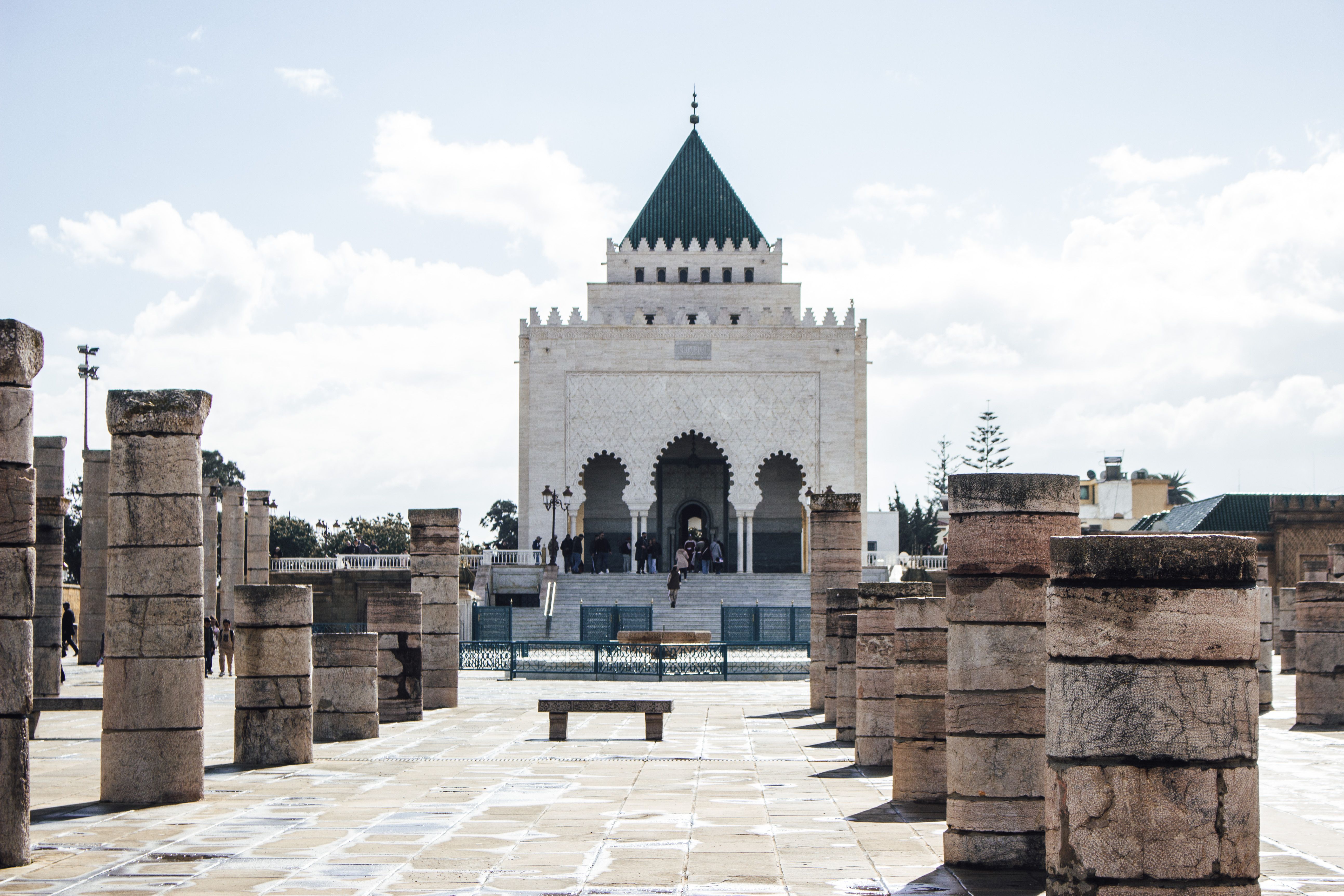
Drive to the Hassan Tower esplanade — the vast open space containing the incomplete twelfth-century tower, the remains of the columns of the mosque that was never finished, and the Mohammed V Mausoleum. The mausoleum, built in 1971 to house the remains of King Mohammed V, is a masterpiece of traditional Moroccan craftsmanship — carved stucco, zellij tilework, and cedarwood joinery in a vast white marble hall. It is one of the few religious monuments in Morocco open to non-Muslim visitors.
Late Morning: Kasbah of the Udayas
Walk through the Bab Oudaia — the twelfth-century Almohad gate that is the most beautiful in Rabat — into the Kasbah of the Udayas. The Kasbah is a compact hilltop neighbourhood of brilliant white-painted houses with blue doors and carved stucco surrounds, built by Andalusian refugees expelled from Spain in the seventeenth century. The lanes are narrow, the light is extraordinary, and the Andalusian garden — a formal Moorish garden of citrus trees, geometric flower beds, and running water — is a place of remarkable serenity. At the northern end of the Kasbah, a platform overlooks the point where the Bouregreg river meets the Atlantic — one of the finest views in Morocco.
Lunch: Rabat
Lunch in one of Rabat’s excellent restaurants — the city has a sophisticated dining scene that reflects its cosmopolitan character as a diplomatic capital.
Afternoon: Medina & Return
A short walk through Rabat’s medina — less intense than Fes or Marrakech, manageable and authentic, with a souk that serves the city’s population rather than its tourists. Return to Casablanca by late afternoon.
What’s Included
- Private transport Casablanca–Rabat–Casablanca
- Expert English-speaking licensed guide
- Entrance fees: Chellah, Mohammed V Mausoleum
- Guided tours of all main sites
- Lunch in Rabat
What’s Not Included
- International flights to and from Morocco
- Travel insurance
- Personal drinks and snacks
- Tips for guide and driver
- Visa fees where applicable
- Personal expenses
Travel Tips
Rabat is a city that rewards wandering — if your schedule allows, spend extra time in the Kasbah of the Udayas rather than rushing to tick every site. The Bouregreg marina along the riverbank below the Kasbah has excellent cafés for a break. The Chellah is best visited in the morning when the storks are most active and the light through the trees is beautiful. Rabat’s medina is excellent for textiles and traditional crafts without the pressure of Marrakech or Fes.
Frequently Asked Questions
Q: Can this tour be combined with a visit to Salé? A: Yes — Salé, the sister city across the Bouregreg estuary, has a beautiful medina and the Merinid Medersa of Salé, which is less visited than the famous madrasas of Fes but architecturally comparable. A brief ferry crossing from Rabat’s marina brings you there in minutes.
Q: Is Rabat better as a day trip or an overnight stay? A: For a thorough experience, an overnight stay allows you to see the Kasbah at golden hour, have dinner in the city, and visit the Chellah in the morning light. But as a day trip from Casablanca, Rabat’s main highlights are comfortably accessible in a full day.
Q: What makes Rabat different from Morocco’s other imperial cities? A: Rabat is Morocco’s only imperial city that is also a functioning modern capital — it has the historical monuments of Meknes or Fes but also tree-lined boulevards, embassies, contemporary restaurants, and a quality of life that gives it a completely different atmosphere from the tourist-facing medinas of the other imperial cities.